Rethinking Directiveness
A CoachBot research partnership with Stellenbosch Business School

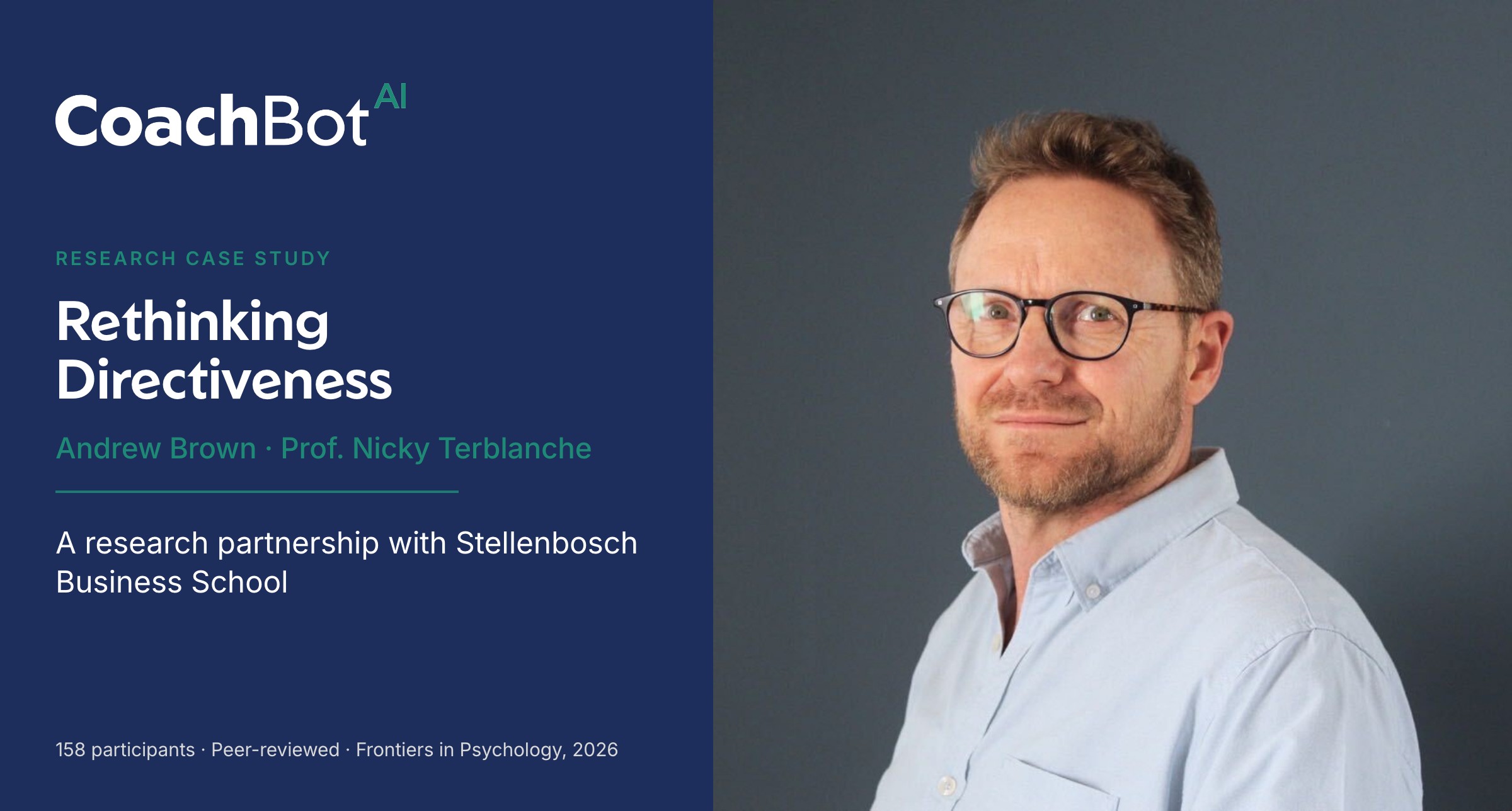
Andrew Brown is a Johannesburg-based strategy and leadership coach with twenty-five years in IT, including fifteen in healthcare IT. That combination, a career built in technology followed by a second one built in coaching, shaped what he wanted to study when he began his master's degree at Stellenbosch Business School: whether AI coaching chatbots actually need to follow the same rules human coaches do.
His supervisor for that question was Prof. Nicky Terblanche, whose own research has helped build the evidence base for AI coaching, including peer-reviewed work comparing AI and human coaching outcomes (Terblanche et al., 2022, PLoS One) and studies on generative coaching chatbot adoption (Terblanche, 2024a, 2024b). Andrew's first attempts at building a research instrument were in ChatGPT. When those hit their limits, on structure and on data protection, it was Terblanche who pointed him toward CoachBot.
The Challenge
Organizational coaching has largely settled on non-directive practice as the professional standard. The International Coaching Federation endorses it, and most human coach training reinforces it: ask, don't tell; facilitate, don't prescribe. Andrew and Terblanche wanted to test whether that preference actually holds once the coach is an AI rather than a person, a question the field had mostly assumed the answer to rather than tested.
Testing it meant building a working research instrument, and Andrew's early prototyping on ChatGPT and Copilot ran into two real obstacles. The bots would loop on a single stage of the GROW coaching model instead of progressing through it, which put the entire experimental comparison at risk. And the research depended on participants sharing real personal coaching goals, something that could not responsibly live on an open, general-purpose platform under South Africa's POPIA, or the GDPR standard it mirrors.
Building the Experiment: D-Bot and N-Bot
Working with CoachBot, Andrew built two chatbots for the study: D-Bot, deliberately directive, and N-Bot, deliberately non-directive. Both followed the same four-stage GROW structure (Goal, Reality, Options, Will) and shared the same underlying prompt architecture. The only difference between them, about eight percent of total prompt word count, was the coaching-style instruction itself, which meant any difference participants reported could be attributed to coaching style and nothing else.
The directive and non-directive characters were grounded in Heron's (2001) six-category intervention model, translated into concrete behavioral statements drawn from the Coaching Behaviour Questionnaire (De Haan and Nilsson, 2017). Before the study launched, eight experienced business coaches independently tested both bots and confirmed the two styles were clearly distinguishable, a detail worth holding onto, because several of those same coaches said, unprompted, that they personally preferred the non-directive one. Coachees, as the results below show, did not agree.
What the Research Found
The study is now peer-reviewed and published. Data came from 158 UK-based millennial professionals (79 per condition) recruited via Prolific, each completing a single 5–15 minute coaching session with one of the two bots.
Construct | D-Bot | N-Bot | Cohen's d | p-value | Favors |
|---|---|---|---|---|---|
Performance expectancy | 3.83 | 3.53 | 0.38 | 0.02* | D-Bot |
Working alliance — Task | 3.84 | 3.59 | 0.31 | 0.05* | D-Bot |
Working alliance — Goal | 4.03 | 3.63 | 0.59 | 0.01* | D-Bot |
Working alliance — Bond | 3.07 | 2.96 | 0.13 | 0.43 (ns) | — |
Goal attainment | 3.80 | 3.57 | 0.28 | 0.08* | D-Bot (trend) |
*Statistically significant at p < 0.05, or a reported near-significant trend at p < 0.10. Condensed from the full construct set in the published paper; AIDUA sub-constructs beyond performance expectancy showed no significant differences.
Coachees rated the directive chatbot significantly higher on performance expectancy, the strongest known predictor of whether people actually adopt an AI tool, and on the goal and task dimensions of working alliance. Goal attainment showed the same directional pull toward D-Bot, though it stopped just short of conventional significance. The one dimension where the two bots did not differ was bond, the relational warmth of the interaction, suggesting that for AI coaching, structure and clarity in getting somewhere may matter more than how the conversation feels along the way.
Personality shaped the pattern further: extraversion, conscientiousness, and openness to experience each significantly moderated which style people preferred, most visibly on performance expectancy and on the working alliance's task and goal dimensions.
What's Next
Terblanche and Brown's own paper points to three directions for the research to grow, each explicitly framed there as a next step rather than a settled conclusion: replicating the study with more diverse and non-UK populations and with Gen Z participants; building adaptive AI coaching systems that adjust their directiveness in real time based on the user's personality; and testing human-AI hybrid models that combine human coaching sessions with regular AI chatbot check-ins.
Andrew's own next step, separate from the published research, is to build a personal AI coaching companion for his own practice, one informed by his session notes and client history, designed to extend the relationship between sessions rather than replace it.
Why This Matters
For coaching providers: this is peer-reviewed evidence, not a vendor's anecdote, that directive interventions (sharing a framework, giving an example, recommending a next step) are legitimate coaching behavior in AI contexts. Treating non-directive coaching as the only professionally sound standard may simply not transfer once the coach is an AI.
For HR leaders: the paper's own framing is direct. Directive AI coaching chatbots could be a genuinely cost-effective way to extend structured, goal-based coaching down to early-career and junior-management employees who are currently priced out of coaching budgets entirely, without waiting for a broader shift in coaching philosophy to catch up first.
In Andrew's Words
“CoachBot.ai is uniquely close to the cutting edge of professional coaching research, translating validated methods, ethical guardrails and rigorous measurement into practice so organisations can deliver evidence-based coaching at scale. I have witnessed this firsthand as a coach and master’s student at Stellenbosch University doing research under the leadership of Prof. Nicky Terblanche on directive vs. non-directive coaching together with CoachBot AI.” Andrew Brown, Stellenbosch Business School
Citation
Terblanche, N. H. D., & Brown, A. B. (2026). Rethinking directiveness in AI coaching chatbots. Frontiers in Psychology, 17:1822088. https://doi.org/10.3389/fpsyg.2026.1822088
Ethical approval: Stellenbosch Business School, project no. 33609. Data availability: raw data available from the authors on request.
Lewin Keller
Founder & CEO
Ex. Google, DoiT, Accenture · ACTP Coach · Investor & Advisor
Keep reading.
29 August 2026
Why Enterprise Coaching Investments Aren't Delivering — And What L&D Leaders Can Do About It
The coaching budget is not the problem. Where it lands is. What the 2026 data shows about the gap between coaching spend and coaching reach.
21 August 2026
Complement or compromise? A practitioner's guide to choosing AI tools responsibly
AI tools are entering coaching faster than our shared standards can evolve. Ten questions that separate a tool which complements your practice from one that quietly compromises it.
18 August 2026
From Boutique Expertise to Enterprise Scale: How D4S Partnership Built SOLAS with CoachBot
How a UK leadership consultancy built a proprietary AI coaching companion without compromising on IP, client trust or ICF-aligned standards — and won a landmark mandate by demonstrating it live.