Build vs. Buy AI Coaching: What Coaching Providers and HR Should Own in 2027
Why a prompted bot isn't a coaching system, what OpenAI’s Custom GPT shutdown reveals about hidden maintenance costs, and seven questions to ask any vendor.

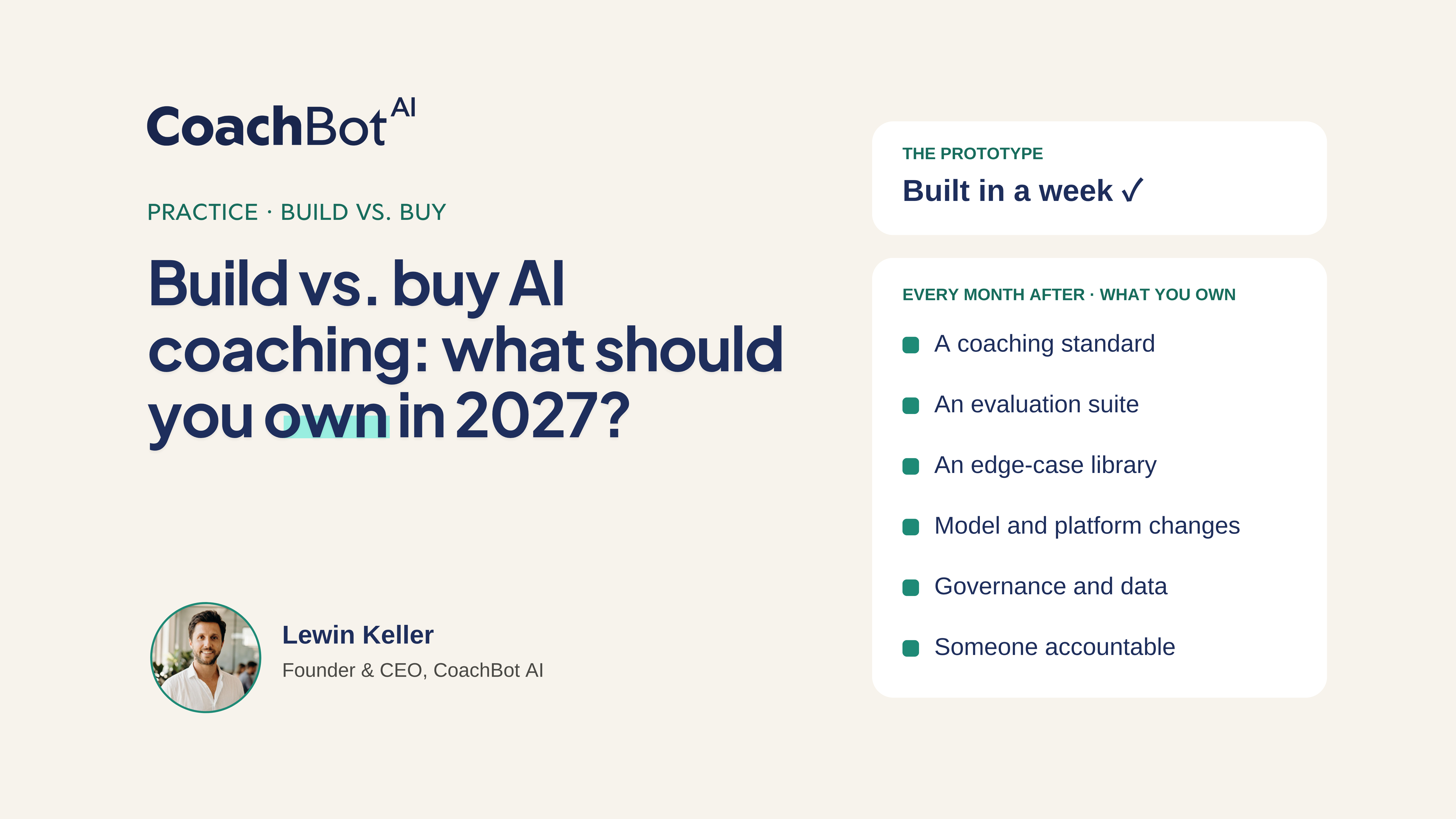
Building an AI coach has never been easier. Building one that still coaches well in month twelve is a different job, and that job is what you are actually deciding to take on.
If you run a coaching practice or lead L&D, you have probably been here: someone on the team builds a coaching GPT over a weekend, the demo lands, and the question follows. Why pay a vendor when we can build it ourselves?
It is a fair question. This article gives you an honest way to answer it, with market data, a recent platform shift that affects many DIY coaching bots, and a short list of questions to put to any vendor. Including us.
The market has already moved toward buying
In 2024, enterprises were split almost evenly: 47% of AI solutions were built in-house, 53% purchased. By late 2025, 76% of enterprise AI use cases were purchased rather than built, according to Menlo Ventures' survey of 495 US enterprise AI decision-makers (Menlo Ventures, Dec 2025).
Menlo's explanation is not that internal teams stopped building. It is that ready-made solutions reached production faster and showed value sooner.
The other side of the ledger is just as clear. Gartner predicts that over 40% of agentic AI projects will be canceled by the end of 2027, citing escalating costs, unclear business value, and inadequate risk controls (Gartner, Jun 2025). Gartner's analysts point to a recurring pattern: proofs of concept driven by hype, where teams underestimate what it costs to run agents at scale.
Neither number means building is wrong. They mean that the prototype is rarely where projects fail. The failure comes later, in cost, quality, and governance.
If your coaching bot is a custom GPT, you already have a migration project
On September 11, 2026, OpenAI announced it will retire custom GPTs across ChatGPT plans and move users to plugins. Custom GPTs are scheduled to stop running on December 11, 2026, and personal accounts can no longer create or publish new ones (Virtualization Review; OpenAI migration guide).
Migration is possible, but not lossless. Existing conversations do not move over, the selected model does not carry over, and custom actions may need to be rebuilt.
For coaching, that list matters. Conversation history is the between-session continuity that makes AI coaching useful in the first place.
This is not a one-off. OpenAI's own deprecation log shows the same pattern for builders one layer down (OpenAI deprecations):
Tool | Announced | Shutdown |
|---|---|---|
Custom GPTs (ChatGPT) | Sep 11, 2026 | Dec 11, 2026 |
Evals platform (API) | Jun 3, 2026 | Nov 30, 2026 |
Agent Builder (API) | Jun 3, 2026 | Nov 30, 2026 |
Assistants API | Aug 26, 2025 | Aug 26, 2026 |
None of this is a criticism of OpenAI. Platforms evolve, and the replacements may be better. The point is who absorbs the change. When you build, your team does. When you buy, your vendor should, and you should ask how.
A chatbot that sounds like a coach is not a coaching system
A good prompt can make any model sound like a coach in a ten-minute demo. The difference shows up in month three, under pressure, with real people.
David Meehan, who has built coaching agents on platforms from Microsoft Foundry to LangGraph, puts it simply in Why Building Your Own AI Coach Is the Easy Part. Agents are becoming like websites. Builders made publishing easy. They did not make every site good.
His test case is one every coach knows. An executive keeps asking: "Just tell me what I should do."
A prompted chatbot follows its "don't give advice" rule until the pressure builds, then gives in.
A coaching system recognizes the boundary is being tested, holds it because the rule is defined at that point in the conversation, and has been tested against that exact situation before a real client hits it.
And sometimes the right answer is not to hold the line. Research by Andrew Brown and Prof. Nicky Terblanche, built on CoachBot with 158 professionals, found a directive GROW chatbot outperformed a non-directive one (Rethinking Directiveness). When an AI coach should shift into a more directive mode is a coaching question. It deserves evidence, not a guess buried in someone's prompt.
What you actually sign up for when you build
The prototype is a week. The capability is an ongoing operation. If you build, plan to own all of this:
What you own | What it takes | Why it matters for coaching |
|---|---|---|
A coaching standard | A written definition of good coaching your system is measured against | Without it, "good" means whatever the model does today |
An evaluation suite | Test conversations for every failure you find, re-run on every change | Stops fixed problems from returning with the next model update |
An edge-case library | Real situations, captured and turned into tests over months | This is where most of the learning happens, after the demo |
Model and platform change | Re-testing and migrating when providers ship or retire tools | See the table above: this is now routine, not rare |
Governance and data | GDPR, EU AI Act readiness, works council questions, data residency | HR and coaching clients will ask before anyone signs |
Someone accountable | A named owner who decides what good looks like next quarter | Quality drifts when nobody owns it |
None of these is impossible. Each is a real line in a budget and a real role on a team. The honest question is whether your organization wants to build expertise there, or somewhere closer to its core.
The better question: what do you want to own?
Build vs. buy is a false binary. Nobody asks whether to "build or buy a website" anymore. Companies use a platform, keep a team for what is distinctive, and hire specialists for the hard parts. AI coaching is heading the same way.
If AI coaching is an experiment, build something this week. The tools are good enough. If it is becoming a real capability, decide where your expertise should live.
For coaching providers. Your methodology is your IP. Own it, and own the client relationship and the brand experience. What you probably do not want to own is the AI engineering underneath: model migrations, evaluation tooling, data compliance. The right partner encodes your methodology faithfully and keeps it behaving that way, without taking it from you.
For HR and L&D. Own the employee experience, your data, and how coaching connects to your programs and your human coaches. Be skeptical of spending years building a coaching methodology, a quality framework, and an edge-case library from scratch when specialists have already done much of that work.
Where a human coach is involved, they stay at the center. AI's job is the between-session continuity that sustained behavior change depends on, not replacing the session. Where budgets don't stretch to human coaches, the same standard applies: the AI has to coach well on its own, and someone has to prove it does.
Seven questions to ask any AI coaching vendor, including us
If you are evaluating vendors, these questions separate a coaching system from a well-prompted chatbot:
What is your definition of good coaching, and where is it written down? Ask to see it.
How do you evaluate it? What does the test suite cover, how many scenarios, and who reviews results?
What happens when the underlying model changes? Ask how they re-test and how fast they caught the last behavior shift.
Show me a boundary under pressure. Run the "just tell me what to do" test yourself in the pilot.
Whose methodology is it? For coaching providers: does your IP stay yours, and can it be applied faithfully rather than paraphrased?
Where is the data, and who can see it? Hosting region, GDPR, EU AI Act positioning, works council documentation, and which certifications are in place versus planned.
What does a pilot prove, and what does it cost? A fixed scope and a clear success criterion beat an open-ended trial.
A vendor who answers these vaguely is selling the demo. Hold us to the same standard.
Where CoachBot fits
CoachBot is AI coaching infrastructure for coaching providers and enterprise L&D. We encode your coaching methodology into AI agents, build a custom evaluation framework around it, and keep it behaving as models and platforms change. Quality standards are set by our Chief Coaching Officer, Jonathan Reitz, and the Responsible AI Coaching Quality Council. We are EU-hosted, GDPR-compliant, and an ICF Germany Charter Chapter Business Partner.
You keep your methodology, your clients, and your brand. We carry the part that is hard to see in a demo.
Bring us one program. Fixed scope, fixed price, four to eight weeks. You find out whether it works before anyone signs for a rollout. Scope a pilot
If you have a custom GPT that needs a new home before December 11, start there.
Sources
Menlo Ventures, 2025: The State of Generative AI in the Enterprise (Dec 9, 2025)
Virtualization Review, OpenAI to Retire Custom GPTs (Sep 28, 2026)
Related reading
Lewin Keller
Founder & CEO, CoachBot AI, ICF-trained coach (ACTP)
Keep reading.
11 October 2026
Every Manager Is Becoming a Coach. Most of Them Don't Have One.
AI is reshaping what managers do, and coaching their teams is now part of the job. Most managers still get a workshop instead of a coach.
21 September 2026
Why Building Your Own AI Coach Is the Easy Part
Building an AI coach is getting easier. Knowing what good coaching looks like and proving your system delivers it is the harder part. David Meehan on why.
10 September 2026
Rethinking Directiveness
Andrew Brown and Prof. Nicky Terblanche built two GROW coaching chatbots on CoachBot to test whether an AI coach has to be non-directive. 158 professionals later, the directive one came out ahead.